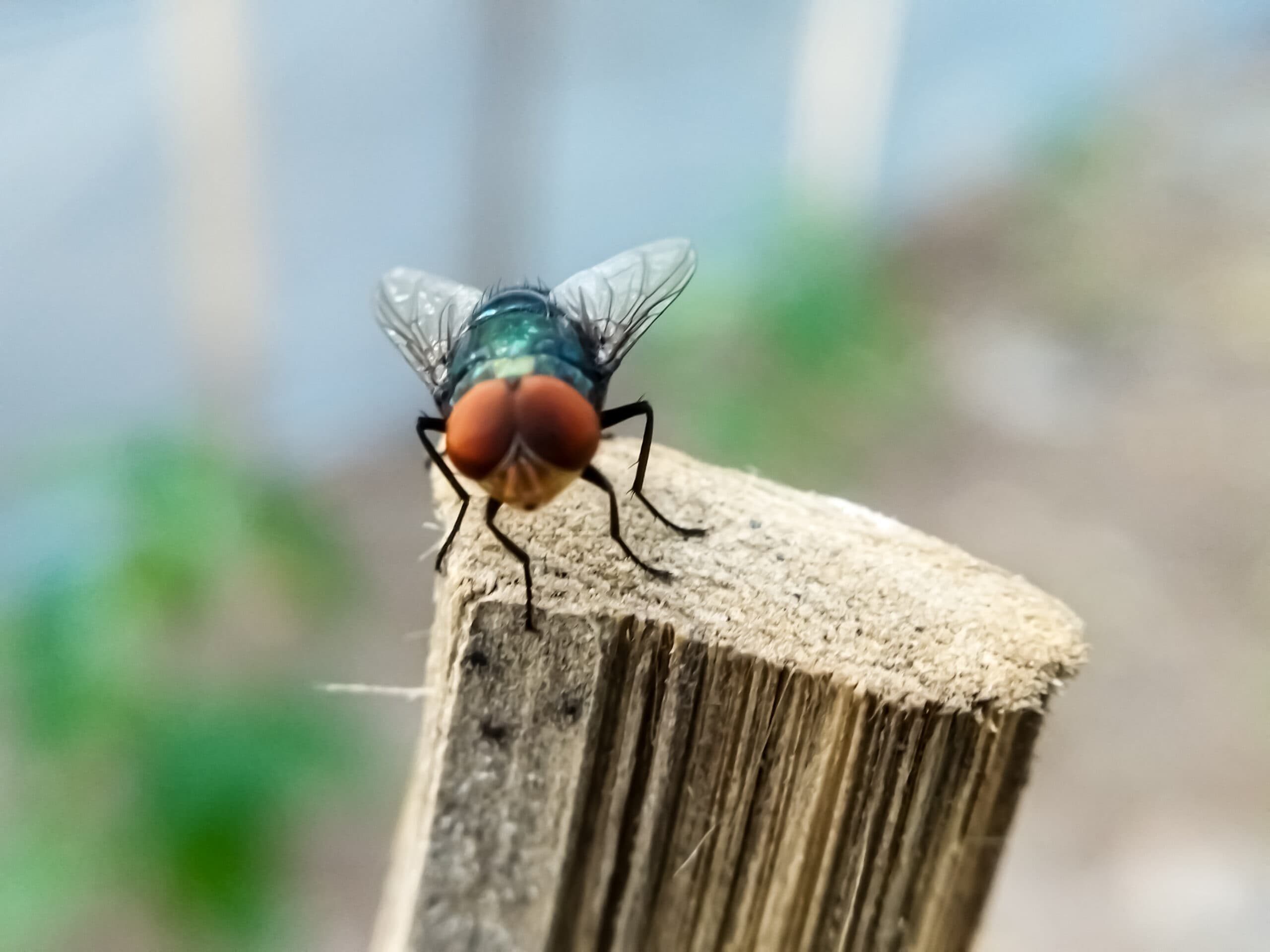
New World Screwworm Reached Texas. Your Hives Are Fine, But The Eradication Program Needs Watching.
New World Screwworm (NWS) was confirmed in a Zavala County calf on June 3, 2026. It’s the first locally acquired case in the U.S. since the 2016-2017 Florida Keys outbreak was eradicated. If you keep bees in Texas and you’ve seen the news, here’s the straight answer: your colonies can’t get screwworm. The fly only breeds in the living flesh of warm-blooded animals. It lays its eggs at an open wound or a mucous membrane, and the larvae feed on living tissue. Blood, body heat, a fresh wound. A honeybee colony offers none of that.
The part worth a beekeeper’s attention is the eradication response. Texas is coordinating that effort through the Texas Animal Health Commission and the Department of Agriculture, and it leans on compounds you’ll want to understand if you keep hives anywhere near livestock country.
Your Colonies Aren’t a Host for the Fly
Cochliomyia hominivorax, the screwworm fly, needs a live, warm-blooded mammal with an open wound or mucous membrane. Cattle, deer, dogs, hogs. Anything that bleeds and gets hurt in the field. Adult flies home in on the smell of wounds and decomposition. A honeybee colony gives off wax, propolis, and floral compounds. None of that smells like a wound, and none of it triggers the fly to lay eggs. That’s the biological reason your hives are safe from the fly itself.
The USDA’s primary eradication tool is the Sterile Insect Technique, and it isn’t a chemical program. Sterile male screwworm flies are produced in bulk and released to outcompete fertile wild males for mating. Here’s the part that makes it work: a female screwworm mates only once in her life. Mate her with a sterile male and that one chance is spent. Her eggs never hatch, and there’s no second mating to fall back on. Release enough sterile males and the wild population collapses on its own. A sterile-fly dispersal facility at Moore Air Base near Edinburg was completed in February 2026, handling up to 100 million flies a week, and a separate production facility built to turn out around 300 million a week broke ground there in April 2026. Either way, those flies don’t interact with your colonies.
The Compounds Going on South Texas Cattle Right Now
The USDA APHIS pesticide document, revised April 2026, is the authoritative list of what’s registered to treat the pest on animals. It’s a treatment document, so it covers what goes on the livestock, not what’s foraging nearby. Several compounds on it are highly toxic to bees on contact. Here’s what’s on the list and what it means for a hive in the neighborhood.
Permethrin Is at the Feed Store Right Now
Permethrin leads the list. Multiple products are EPA-registered for NWS treatment on beef cattle, dairy cattle, sheep, goats, horses, and hogs. Prozap Screw Worm Aerosol and Catron IV are two examples, both sold over the counter at livestock supply stores. No license, no permit, no notification when a rancher reaches for it. And EPA classifies permethrin as highly toxic to honey bees on contact.
Coumaphos Takes a License. Permethrin Doesn’t.
Coumaphos is on the list too. Co-Ral Flowable is registered for the same use on beef cattle, non-lactating dairy cattle, and horses, and APHIS holds a Section 18 emergency exemption for Tanidil, a coumaphos-propoxur wound treatment. Beekeepers may know this one already. Coumaphos is the active ingredient in CheckMite+ strips, used inside hives against varroa and small hive beetle. The same chemistry some keepers hang in a brood box is hard on bees when it’s coming off a treated animal outside it. Coumaphos is also a restricted-use pesticide, so unlike permethrin it takes a licensed applicator to buy and apply it.
That license is the difference that matters to you. A licensed application is the kind that can land in a notification registry, if you’re set up to see it. An over-the-counter permethrin purchase at the feed store generates no paperwork and no warning at all. Most of what a neighbor could spray near your bees is that second kind.
The way it reaches your hives is spray drift during application and residue on vegetation near treated areas. Bees don’t forage on treated livestock, so pollen and nectar aren’t the route. Knowing what’s going on the ground around you, and when, is basic apiary awareness. If you’re running hives near cattle country in South Texas, it’s time to have that conversation with your neighbors.
“The screwworm can’t touch your hives. What gets sprayed to stop it can. That’s where a beekeeper pays attention.”
Aerial Malathion Is the Scenario to Watch
Texas Agriculture Commissioner Sid Miller wants the Screwworm Adult Suppression System (SWASS) deployed. It’s a ground bait program that targets adult flies. He’s pushed USDA to authorize and fund it since last summer. As of this writing, it hasn’t happened. But the scenario that should worry beekeepers is a separate one.
Fyfanon ULV AG is malathion, registered for pasture and rangeland on that same APHIS list. ULV means ultra-low-volume, a concentrated spray that goes out by ground rig or by aircraft. A large aerial malathion broadcast over South Texas rangeland would be the worst outcome for bees in this whole campaign. The product is already registered for that use, so no new EPA approval would be needed. What it would take is a decision to send it up.
And let’s be absolutely clear: nobody has made that decision. The same APHIS document notes that listing a product “does not imply endorsement” by the USDA. The malathion is on the shelf, registered and available, but not loaded into any plane. The deployment decision is the thing to watch. That’s the moment the risk to your bees changes.
A ground bait program like SWASS would be the lower risk to bees. The bait mimics the odor of decomposing tissue, which pulls flies, not bees. Targeted stations on the ground are manageable for an apiary nearby. An aerial malathion broadcast over open rangeland is a different animal.
The Quarantine Is a County List, and It Moves
The quarantine is a list of counties, not a fixed radius, and it changes as new cases turn up. As of mid-June 2026, the Texas Animal Health Commission has thirteen counties under quarantine: Coke, Edwards, Gillespie, Kerr, Kimble, La Salle, Schleicher, Sutton, Tom Green, Uvalde, Val Verde, Webb, and Zavala. That reaches well up into the Hill Country, so don’t assume your county is clear. Check the TAHC screwworm page for the current list. If you’re in or near the zone, watch APHIS and TAHC now, and watch for the deployment method, not just whether something gets authorized.
If you’re in those counties, it’s worth calling your county Extension office to find out whether any application programs are being coordinated locally. Talk to neighboring ranchers about their treatment plans. It’s a conversation that’s easier to have before an event than after.
TAIS Registration and BeeCheck Are Your Actual Tools
Two registrations matter here, and neither one works the way the rumor mill says.
Texas Apiary Inspection Service registration costs $35 a year. It’s voluntary in Texas, and it’s what puts your operation on the state’s radar for inspection and disease monitoring. One thing it does not do is hand your location around. TAIS keeps apiary locations confidential and doesn’t share them with anyone. Under Chapter 552 of the Texas Government Code, your apiary location is protected from public disclosure.
The tool built specifically for spray drift is FieldWatch, a free mapping system run by a nonprofit. Most people know it by its crop-side name, DriftWatch, but that side is for specialty-crop growers. Beekeepers use the companion registry, BeeCheck. You put your apiary on the map, a state data steward verifies it, and registered pesticide applicators can look it up before they spray. Your pins aren’t public. They’re visible to the data steward and to the applicators who check the map, not to the world.
Two honest caveats. It’s voluntary, and it only works if the person spraying actually checks the map. There is no Texas law that guarantees you a 48-hour phone call before a bee-toxic application. BeeCheck plus knowing your neighbors is the actual protection, not a notice the rumor mill promised you.
Where a Managed Operation Actually Helps
A managed hosting arrangement doesn’t buy you a legal right to a warning. It buys you somebody whose job is to know. A working beekeeper keeps the apiary mapped on BeeCheck, watches what’s happening on the surrounding land, and talks to the neighbors before anything goes in a tank. A hobbyist who set hives out and checks them on weekends doesn’t have that awareness, and the state isn’t going to supply it for them.
Getting on BeeCheck and keeping TAIS registration current is worth doing, New World Screwworm or not. Spray drift happens every season in Texas. It’s cheap groundwork most beekeepers skip and then wish they hadn’t.
We manage hosted hives for Central Texas landowners, we’re TAIS-registered, and our apiaries are mapped on BeeCheck. If you’re hosting hives on your property and want to know whether your setup has that layer of awareness, talk to us about our managed hive hosting program.
OUR MANAGEMENT PHILOSOPHY
Every hive we manage is held to a written standard: hygienic behavior, varroa resistance, queen veracity, and performance in Central Texas conditions. Genetics that don't hold up get replaced — not propped up.
Read Our Standards