Threats
European Foulbrood in Honey Bees: What EFB Is Telling You
European foulbrood in honey bees kills larvae before cells are capped. Here’s how to identify EFB, distinguish it from AFB, and manage colonies without reaching for antibiotics first.
American foulbrood gives a Texas beekeeper no management decision. Suspect it, and TAIS wants to hear from you immediately. Know it for sure, and reporting stops being optional advice and becomes the law. The colony is then destroyed, regardless of how strong the genetics or how good the queen. This entry is part of the Honey Outlaws pest encyclopedia.
Paenibacillus larvae is the spore-forming bacterium behind American foulbrood, and the spore is the whole problem. The vegetative bacterium, the active growing form, is weak. Heat kills it, and so do most disinfectants and antibiotics. The spore form is a dormant, armored version the bacterium produces under stress, and it shrugs off heat, disinfectants, antibiotics, and drying out. TAIS and the wider beekeeping literature document spores surviving in old comb and equipment for decades. Wood that looks clean and smells fine can still carry spores from an outbreak that happened before the current beekeeper ever owned the yard.
Only larvae get sick. Adult bees carry the spores without symptoms, which is exactly how the disease moves. Nurse bees pick up spores cleaning cells and pass them into larval food without knowing it. A larva that ingests enough spores gets infected in its midgut, the spores germinate into the active bacterium, and the bacterium consumes the larva from the inside. Death comes after the cell is capped, so the first outward sign of AFB is always a dead larva sealed under a cap that’s already starting to look wrong.
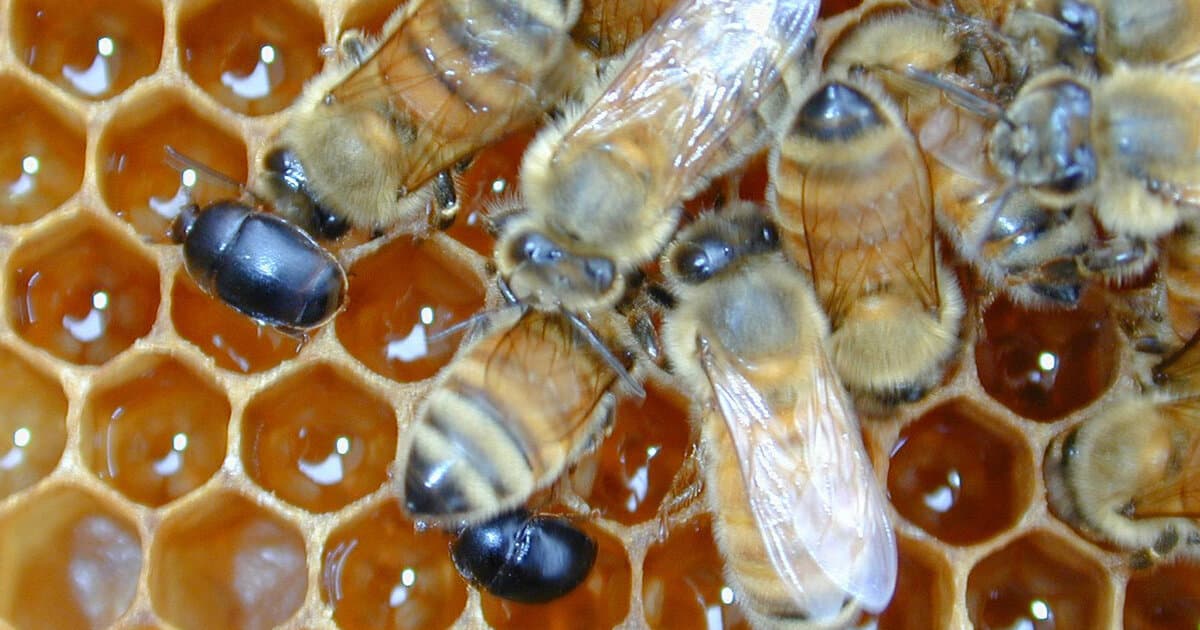
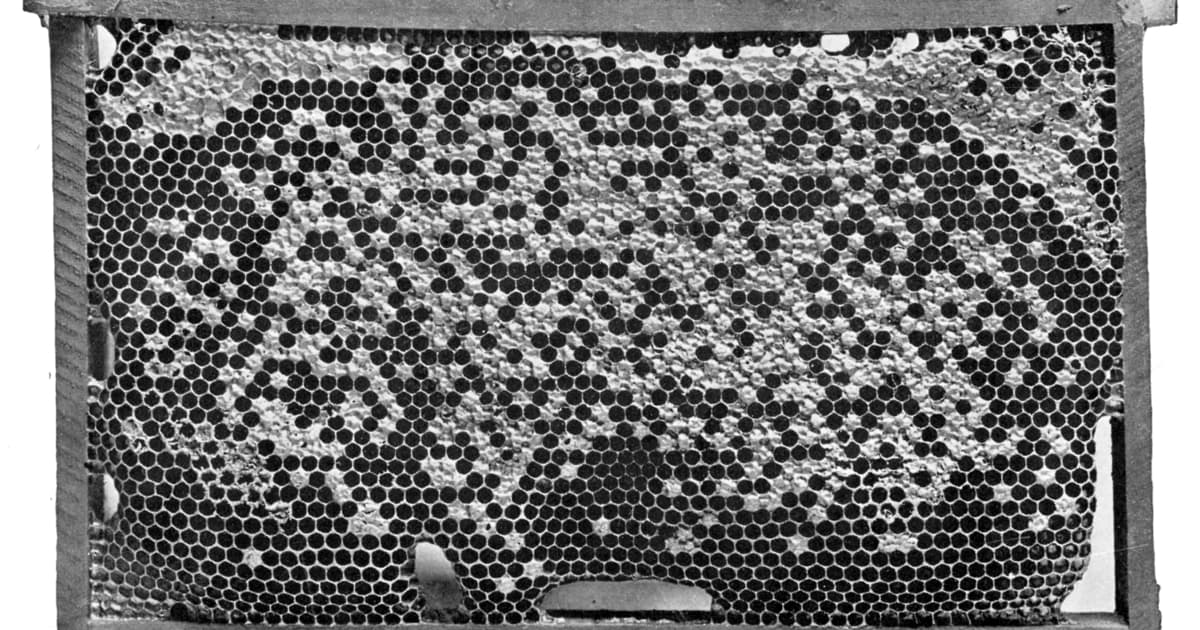
The first visible sign is capping that’s gone wrong. Healthy brood cappings are flat to slightly convex and a consistent tan. AFB-affected cappings sink inward, darken, and often show small, irregular perforations, sometimes with a greasy sheen. A solid brood pattern with a scatter of sunken, punctured cappings is worth a closer look immediately, not next inspection.
Open one of those cells and the diagnosis gets clearer. A healthy larva is pearly white, plump, and curled cleanly in the cell. An AFB-infected larva is coffee brown, collapsed, and either wet and ropy or dried into a flat, dark scale stuck hard to the lower cell wall. That scale carries viable spores and doesn’t scrape off easily.
The ropiness test is the standard field check. Slide a toothpick or matchstick into a suspect cell and draw it back out slowly. Infected material strings out into a brown, sticky thread, often an inch or more, before it snaps. A healthy larva doesn’t rope, and neither does chalkbrood or European foulbrood. A positive ropiness test is about as close to a yes as a field test gets, but it’s still a field test, not a lab-confirmed diagnosis. That gap is exactly why the rule is to report on suspicion instead of waiting to be sure.
Advanced infections carry a sharp, rotten-egg smell, different from the sour note of EFB and different from a healthy hive. Reading a brood frame carefully on a normal schedule is what catches this stage before it spreads past one hive.
AFB doesn’t leave room to wait and see. Call TAIS the moment you suspect it, because a hunch that sits for even a few days is how one sick hive turns into a wiped-out apiary. Once you know for certain, that call is also the law. Texas Agriculture Code §131.025 requires it, and under §131.121, sitting on a confirmed case is a Class C misdemeanor. Call TAIS at [email protected] or 979-321-5827.
A colony with the best genetics in Texas still burns if it’s carrying AFB. Once it’s confirmed, good breeding doesn’t change what happens next.
The chief apiary inspector has the legal authority to seize a diseased colony and order it destroyed, treated, or sold. For AFB, destruction is the only one of those that actually works. The spores don’t respond to treatment, and moving or selling contaminated equipment just spreads the problem to whoever gets it next. TAIS’s recommended method, the one they call most effective, is burning everything the colony touched. That means the bees, the brood, the wax, the honey, the frames, the inner cover, and the bottom board, all of it. Wooden hive bodies can sometimes be scorched clean with a torch instead of burned outright, but nothing guarantees that kills every spore. Burn it, and you know. Scorch it, and you’re trusting a surface treatment against a spore built to survive worse than torch damage to the wood around it.
Close the entrance before you do anything else. A dying or destroyed AFB colony left open to robbing is how spores leave your yard and land in somebody else’s, including your own other hives. The equipment is real money and the colony is real time, but neither one changes what happens next. Waiting to protect either one just multiplies how many hives end up paying for it.
We’ve never had AFB in our own yards. If we ever do, we’ll follow TAIS to the letter, the same as we’d tell any beekeeper facing it to do.
Robbing is the fastest way AFB moves between hives. A dying AFB colony is an easy target, and healthy colonies will rob it out the way they’d rob any weak hive, no exceptions for what’s actually killing it. Robber bees carry contaminated honey and spores straight back to their own colony. Left unchecked, one collapsing AFB hive can expose every colony in range within days.
Beekeepers move it too, usually without meaning to. A hive tool crossed from an infected hive to a healthy one carries spores along with it. Secondhand equipment bought without knowing its history can carry spores from an outbreak nobody mentioned. Moving frames between colonies, even from a strong hive to a struggling one meant as a favor, can move the disease the same way.
Find AFB mid-inspection, and the response starts immediately. Stop the inspection, close the hive back up, flame-sterilize your tools, and call TAIS right away.
Nothing prevents AFB outright, but a few things change the odds by a real margin.
Hygienic genetics come first. A colony with strong hygienic behavior detects and removes infected brood early, often before the disease can fill the cell with spores. Hygienic defenses have limits. A heavy spore load, a robbing event that brings in infected foragers, or a colony already stressed by something else can overwhelm them. Even so, a colony with strong hygienic genetics is a harder target for AFB than one without, which is one more reason genetics sits at the top of how we select breeder stock.
Where your equipment comes from matters just as much. Don’t take on used equipment without knowing its health history. Don’t move frames between apiaries. Buy packages and nucs from inspected, reputable sources. If AFB has shown up anywhere nearby, flame-sterilize tools between yards, not just between hives.
Keep colonies strong on top of that. A strong colony holds hygienic behavior better than a weak one, and an apiary inspected on a real schedule catches trouble before it becomes an apiary-wide problem. AFB spreads best where nobody’s looking.
Everything else on our pest and disease list gives you a number, a threshold, or a decision that genetics and management can shift in your favor. Every colony with AFB gets the same phone number and the same burn pile, no matter how good the genetics are.
Every hive we manage is held to a written standard: hygienic behavior, varroa resistance, queen veracity, and performance in Central Texas conditions. Genetics that don't hold up get replaced — not propped up.
Read Our Standards