Threats
Small Hive Beetle and Honey Bees
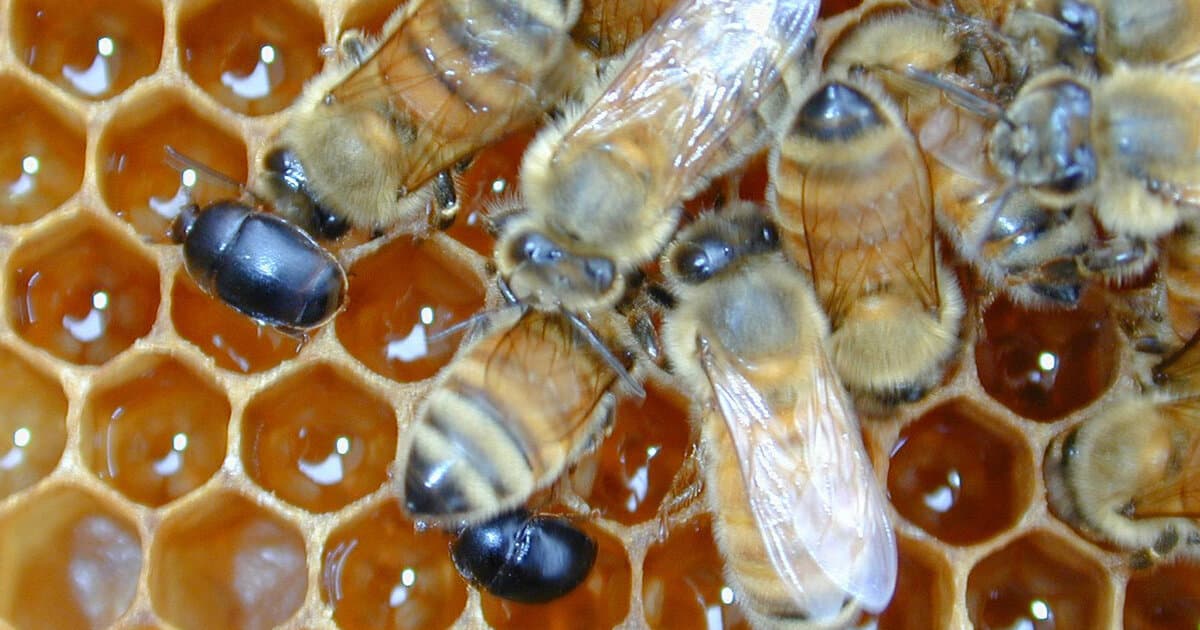
Small hive beetle is established in Texas, active year-round. Here’s the biology, what larvae do to a colony, and why colony strength is the entire SHB program at Honey Outlaws.
European foulbrood in honey bees kills larvae before the cells are capped. Melissococcus plutonius, the bacterium behind it, settles in the larval midgut and competes for food until the larva starves. What’s left is dead, twisted brood in open cells, scattered across the frame in a shotgun pattern. Mistake it for American foulbrood and you’ll burn equipment you never had to. Reach straight for antibiotics and you’ll knock the outbreak down while the reason it started sits untouched.
This entry is part of the Honey Outlaws pest encyclopedia. Read EFB right and fix what let it in, and you’ve done most of the job. We haven’t had it in our own yards, but the framework here is the one we’d run, built on the survivability-first priorities we put on every colony-health problem.
M. plutonius infects larvae younger than 48 hours, before the cell is sealed. They die young, and they die in the cell. A healthy larva is pearly white and plump, coiled in a C at the bottom of the cell. An EFB larva goes yellow, then brown, and ends up twisted and collapsed, slumped against the cell wall instead of lying clean in the base.
The smell is a reliable field mark. EFB gives off a sour, fermented odor, and TAIS treats that smell as a diagnostic sign. It’s acidic and wrong, nothing like the sharp, ropy rot of American foulbrood. Pull frames on a struggling colony, and that sour smell points to EFB.
The brood pattern goes shotgun. The bees find infected larvae and haul them out, which opens cells all across the nest in a scattered pattern. That’s the colony doing its job, and one with strong hygienic behavior clears those cells faster. Some of what looks like heavy damage is the bees cleaning house.
Once a dead larva dries down, it leaves a rubbery brown scale in the bottom of the cell that lifts out clean. That one detail separates EFB scale from AFB scale. AFB scale grips the lower cell wall and won’t come free without a probe. If this scale lifts out easily, that’s evidence for EFB over AFB.
EFB and American foulbrood are both bacterial brood diseases, and that’s about where it ends. One you manage in the yard. The other you report and burn.
American foulbrood (Paenibacillus larvae) forms endospores that survive in wooden equipment for decades. It’s a reportable disease in Texas, and a confirmed case means the colony is destroyed and its woodenware burned. The AFB entry in this series covers the full protocol and the ropy-string toothpick test that confirms the diagnosis.
EFB asks for none of that. Melissococcus plutonius forms no spores, so equipment that’s seen EFB doesn’t carry the same long-lived contamination. You manage these colonies in place, and many of them pull out of it on their own once forage improves.
EFB isn’t reportable in Texas either. No mandatory call, no burn pile. That’s not a reason to shrug it off, since stress that drives EFB season after season is a genetics and management problem worth fixing. But the expensive mistake here is torching a colony you could have requeened.
Infection is opportunistic. TAIS notes that EFB tracks with nectar dearths, high varroa loads, and colony stress. It rarely turns up unless at least one of those is already in play.
“EFB shows up when bees are running on empty: low forage, high varroa, and genetics that can’t compensate. Fix the underlying problem and EFB often clears without you touching the disease directly.”
Spring is when most Texas beekeepers run into it. Colonies are coming out of winter and building fast, but the early forage hasn’t turned into a real flow yet. That gap between what the colony needs and what’s coming in stresses the larvae, and that’s when M. plutonius takes hold. Once a genuine nectar flow lands, a lot of EFB clears on its own.
Varroa pressure makes all of it worse. Heavy mite loads suppress brood, vector viruses, and grind the adult population down across the season. A colony already fighting varroa has less in reserve to pull infected larvae before the bacteria spread. Run a mite wash and know your count before you decide on anything else.
Equipment hygiene plays in too. EFB bacteria move between colonies on shared gear, robbing, and drifting bees. It’s nothing like the decade-spanning spore problem of AFB, but old, dark comb with a disease history isn’t worth saving at the cost of colony health.
The approach follows the same priority order we put on most colony-health problems. Fix the genetics first, take the environmental stress off second, and reach for a chemical only if the first two haven’t done the job.
Requeening with hygienic stock is the main tool. Bees with strong hygienic behavior find and pull diseased larvae before the bacterial load builds, and that’s the trait that makes a colony shrug off EFB over time. A new queen needs six to eight weeks to turn the brood population over, and working the brood frames through that stretch tells you whether the new genetics are clearing it. Treat with antibiotics and stop there, and you’ve buried the outbreak while leaving the susceptibility that caused it. The door’s still open next spring.
Forage sits right next to genetics. If your bees are working a genuine dearth, supplemental feeding eases the nutritional load on the larvae while you deal with the real problem. It’s no cure. It buys time, taking pressure off the brood at its most vulnerable so the genetics can do the work.
Oxytetracycline (Terramycin) is the antibiotic registered for EFB in the US. Tylosin and lincomycin are labeled for American foulbrood, not EFB. Since honey bees were classified as livestock under FDA rules in 2017, using it takes a veterinary feed directive or a prescription. The Honey Bee Health Coalition’s foulbrood guide treats antibiotics as a last resort for EFB, and with reason. They drop the bacterial load for a few weeks. They don’t touch why the colony was open to it in the first place.
A colony that keeps catching EFB through one dearth after another, and never really climbs out, is telling you something about its genetics. That’s a requeen signal. Our beekeeping philosophy puts survivability first, and a colony that needs an antibiotic just to get through spring dearth isn’t the survivor stock we’re after.
Every hive we manage is held to a written standard: hygienic behavior, varroa resistance, queen veracity, and performance in Central Texas conditions. Genetics that don't hold up get replaced — not propped up.
Read Our Standards